
Let me answer the question you actually came here to ask.
Yes, GLP-1 medications have side effects. Most are gastrointestinal, most show up in the first few weeks or right after a dose increase, and most settle down. The rare ones are genuinely rare — but they're the reason this class of medication is prescription-only and the reason a real clinician should be watching your labs, your symptoms, and your dose schedule the whole way through.
That's the short version. Now let me give you the long one, because "monitoring" is a word a lot of telehealth companies use without explaining what it means in practice.
What I Learned Being Patient Zero
I'm Paul. I co-founded tb2.health, and before we had a single patient, I was the guinea pig.
Week three, first titration step up. I remember standing in my kitchen at 9pm, staring at a plate of chicken I'd cooked twenty minutes earlier, and feeling absolutely nothing. No hunger. No interest. Mild queasiness sitting somewhere behind my sternum like a stone. I ate four bites and gave up.
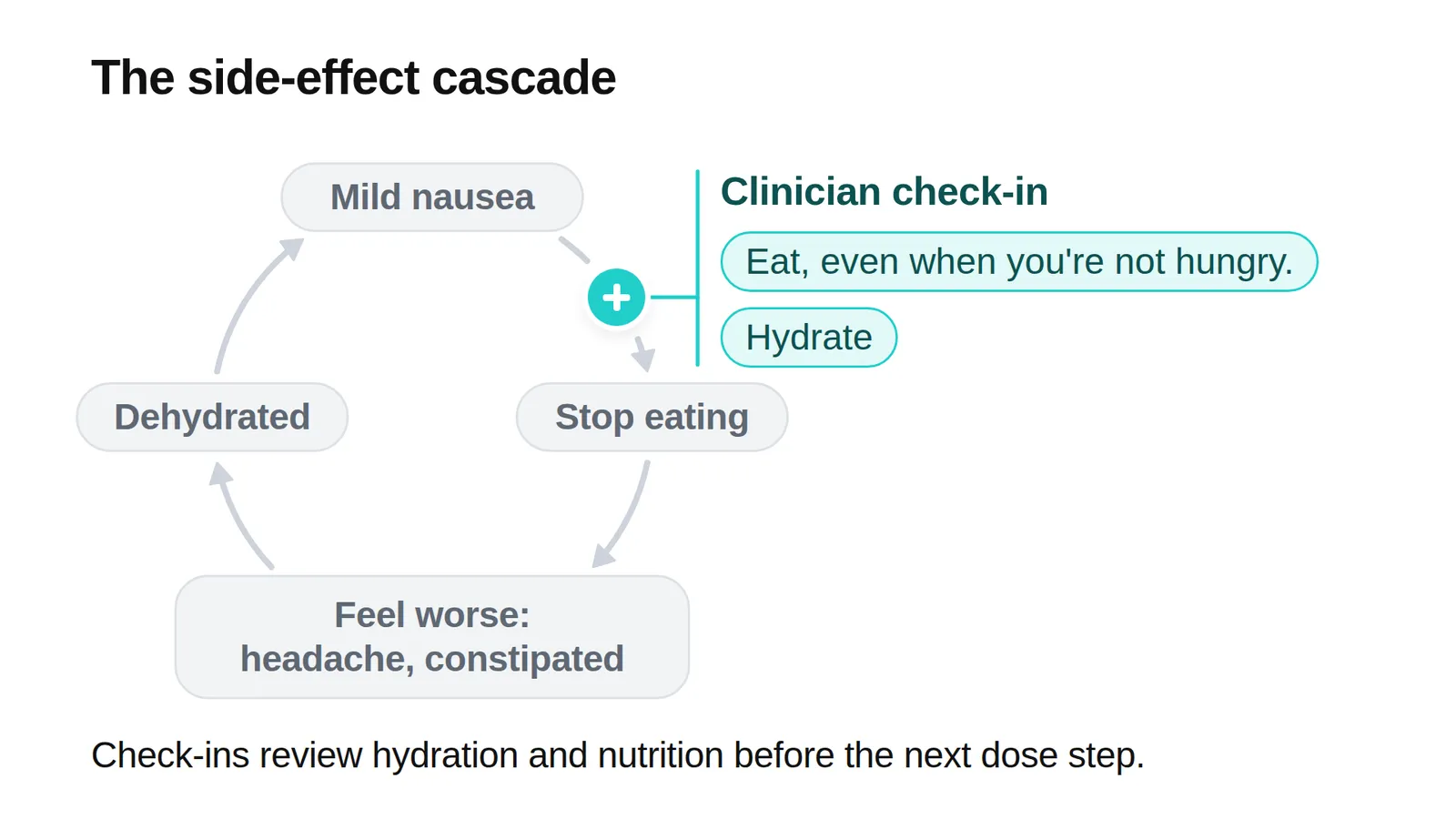
That was the night I understood something that no clinical trial abstract had communicated to me: side effects aren't just a medical event. They're a behavioral one. If you feel mildly nauseated, you stop eating. If you stop eating, you get dehydrated. If you get dehydrated, you feel worse, and now you've got a headache, you're constipated, and you're convinced the medication is "not agreeing with you."
Half the time it's not the medication. It's the cascade.
I'm not a clinician. I want to be direct about that. But I've been on both sides of this program — as the person on the injection and as the person who built the protocol around it — and the thing I care most about is that nobody goes through what I went through in that kitchen without someone to call.

The Side Effects You Should Actually Expect
Let's start with what the data says, not what the internet says.
In the 68-week STEP 1 trial published in the New England Journal of Medicine, gastrointestinal side effects were reported by roughly 74% of participants on active treatment versus about 48% on placebo — but they were mostly transient and mild-to-moderate, and only around 7% discontinued because of them (Wilding et al., NEJM 2021).
Read that again. Three-quarters had something. Fewer than one in fourteen stopped.
Here's the practical breakdown:
| Side effect | How common | What typically helps | When to flag it |
|---|---|---|---|
| Nausea | Very common, especially post-titration | Smaller meals, slower eating, less fat/fried food, ginger, hydration | Persists >1 week or blocks fluid intake |
| Constipation | Common | Fiber, water, magnesium (with clinician OK), movement | No bowel movement 3+ days, cramping |
| Diarrhea | Common | Bland foods, electrolytes, dose review | Dehydration signs, blood, fever |
| Fatigue | Common early | Protein intake, calorie floor, sleep | Persistent or worsening |
| Reflux / bloating | Moderately common | Meal timing, portion size, upright after eating | Nightly symptoms, difficulty swallowing |
| Injection-site reaction | Uncommon | Site rotation, technique review | Spreading redness, fever |
| Gallbladder issues | Uncommon | Medical evaluation | Right-upper-abdominal pain, nausea, fever, jaundice |
| Pancreatitis | Rare | Stop and seek care | Severe persistent abdominal pain radiating to back |
That last row is the one that matters most. A 2023 analysis in JAMA found elevated risk of pancreatitis, gastroparesis, and bowel obstruction with GLP-1 use for weight management compared with an older agent — small absolute numbers, but real ones (Sodhi et al., JAMA 2023). A separate meta-analysis in JAMA Internal Medicine found a modest increase in gallbladder and biliary disease, particularly at higher doses and longer durations (He et al., 2022).
None of that means "don't do this." It means "don't do this alone, and don't do this with a company that ships you a vial and disappears."
Who Shouldn't Take These Medications At All
Safety screening starts before the first dose — not after.
Standard contraindications and cautions for GLP-1 receptor agonists include a personal or family history of medullary thyroid carcinoma or Multiple Endocrine Neoplasia syndrome type 2, prior hypersensitivity to the agent, and pregnancy or active attempts to conceive. Significant caution applies with a history of pancreatitis, severe gastroparesis or other significant motility disorders, active gallbladder disease, and end-stage kidney disease. The FDA's prescribing information for this class carries a boxed warning based on rodent thyroid C-cell tumor findings; human relevance hasn't been established, but the contraindication stands (FDA drug safety information).
There's also a combination-risk question. If you take insulin or a sulfonylurea, adding a GLP-1 raises hypoglycemia risk and your other medications may need adjusting — something the American Diabetes Association addresses directly in its annual Standards of Care.
This is exactly why our intake asks questions that feel excessive. Family thyroid history. Every medication and supplement. Prior abdominal surgery. Eating disorder history. Pregnancy plans. It's not paperwork theater. It's the screening step that determines whether we can safely say yes — and sometimes the right clinical answer is no, or not yet.
How We Actually Monitor Safety
Here's what physician supervision looks like at tb2.health, step by step.
1. Pre-treatment lab work
Before treatment starts, our clinicians review baseline labs. Typically that includes a comprehensive metabolic panel (liver and kidney function), A1c or fasting glucose, a lipid panel, and — depending on your history and symptoms — thyroid function. If you're a woman with signs suggesting PCOS, or someone with markers pointing toward fatty liver, that changes the clinical picture and sometimes the plan.
Baseline labs do two jobs: they screen for reasons not to start, and they give us a reference point. A creatinine value six months from now means very little without one from today.
2. A structured initial health evaluation
Not a two-minute form. A real evaluation of your medical history, medication list, prior weight history, comorbidities, and goals. This is where a licensed clinician decides whether GLP-1 therapy is clinically appropriate for you — and, honestly, whether something else should come first.
3. Conservative dose titration
Dose escalation is the single biggest lever on side-effect burden. Start low. Go slow. The manufacturer-recommended titration schedule is a ceiling, not a mandate — and clinical judgment often means holding at a dose longer than the label's default pace.
I held at one step for nine weeks. Not because anything was wrong. Because I was doing fine there and there was no reason to push.
Dosage optimization means finding the lowest effective dose you tolerate well. It does not mean racing to the top of the ladder.
4. Scheduled check-ins with symptom review
Regular touchpoints where a clinician reviews tolerability, hydration, nutrition intake, and any new symptoms before authorizing the next titration step. If you're struggling, the answer is a dose hold or a step back — not "push through it."
5. Ongoing lab monitoring
Repeat labs at clinically appropriate intervals to track kidney function, glucose control, and liver markers over time. Some people's blood pressure or diabetes medications need to be adjusted as metabolic health shifts. That's a good problem, but it's still a problem that requires a clinician.
6. Defined escalation pathways
Every patient gets a clear answer to "what do I do if something feels wrong at 11pm on a Saturday?" You message your care team. Red-flag symptoms — severe persistent abdominal pain, repeated vomiting, signs of dehydration, allergic reaction — go straight to urgent care or the ER, and we say so explicitly rather than burying it in a PDF.
7. Perioperative and procedural coordination
This one gets missed constantly. Because these medications slow gastric emptying, there's a documented aspiration risk with anesthesia. A 2024 multisociety clinical practice guidance from the American Society of Anesthesiologists and partner organizations replaced blanket "hold the medication" advice with an individualized, risk-stratified approach (ASA multisociety guidance).
Translation: tell your surgeon, your dentist, and your anesthesiologist that you're on a GLP-1. Every time. And tell us, so we can coordinate.
The Side Effect Nobody Warns You About
Under-eating.
When appetite signaling changes, some people simply stop consuming enough protein and enough calories to maintain lean mass. That's not a medication side effect in the pharmacological sense — it's a behavioral one — but it produces real consequences: fatigue, hair shedding, poor recovery, and loss of muscle alongside fat.
Research on obesity pharmacotherapy consistently shows that a meaningful fraction of weight lost is lean tissue, which is why the NIDDK and essentially every obesity medicine society frame these medications as one component of a program that includes nutrition and physical activity — not a standalone intervention.
So: Eat, even when you're not hungry. Prioritize protein at every meal. Add resistance training two or three days a week. Hydrate — genuinely, boringly, constantly.
I keep a water bottle on my desk purely out of spite for week-three Paul.
A Word From the Guy Who Isn't a Doctor
Everything above is education, not medical advice. I can tell you what the trials found and how our protocol is designed. I cannot tell you whether a specific symptom you're having is normal, whether your dose should change, or whether this class of medication is right for your body and your history.
Only a licensed clinician who has reviewed your labs and your full medical history can do that. If you're an active patient, message your care team — that's what they're there for, and there's no such thing as a question too small. If you're not a patient anywhere yet, talk to your primary care provider before you buy anything from anyone, including us.
The companies that make this sound frictionless and risk-free are the ones I'd be most cautious about.
What Good Supervision Feels Like
It feels a little slower than you want. It feels like someone asking about your bowel habits when you'd rather talk about the scale. It feels like being told to hold a dose when you were hoping to move up.
And then, six months in, it feels like the reason nothing went sideways.
The side effects are manageable for most people. The serious risks are uncommon and screenable. What separates a safe experience from a miserable one usually isn't the molecule — it's whether anyone was paying attention.
If you want to know whether you're a candidate, and what our clinicians would want to check before saying yes, start with our evaluation at tb2.health. Worst case, you learn something useful about your own metabolic health. That's not a bad worst case.
Go eat some protein.
— Paul Moss, Co-founder, tb2.health
This article is for educational purposes only and is not medical advice. GLP-1 medications are prescription treatments that require evaluation by a licensed clinician. Individual results and experiences vary. Always consult a qualified healthcare provider before starting, changing, or stopping any medication.