

You already know GLP-1 medications exist. You've seen the headlines, maybe heard a coworker talk about it in the break room, and now you want to know what actually happens inside a program. Not the marketing version. The mechanical version.
Fair. That's what this is.
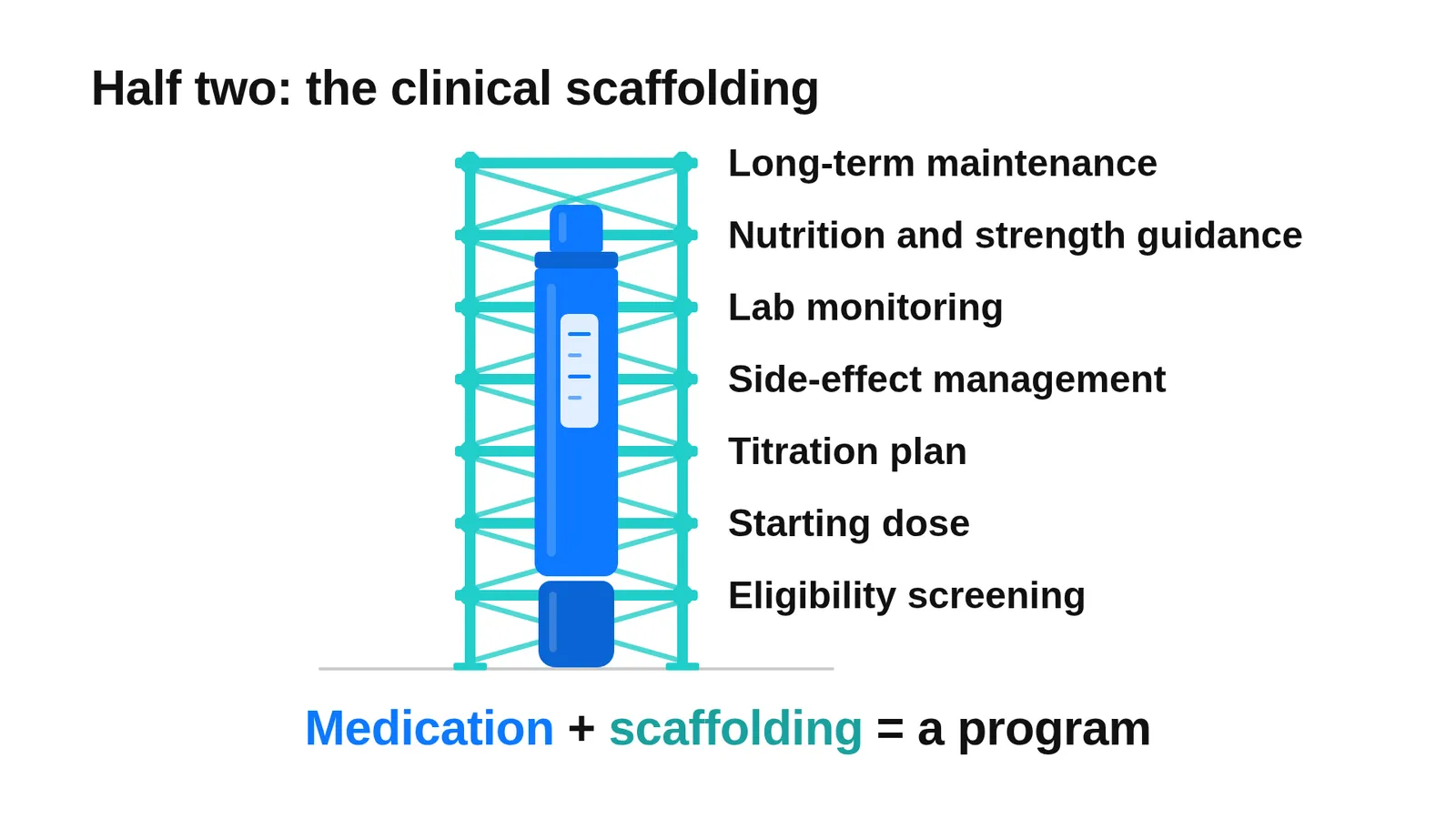
Here's the short answer up front: a medically supervised GLP-1 program has two halves that only work together. Half one is the medication, a prescription that mimics gut hormones your body already makes to regulate appetite and blood sugar. Half two is the clinical scaffolding around it: eligibility screening, a starting dose, a titration plan, side-effect management, lab monitoring, nutrition and strength guidance, and a long-term maintenance conversation. Take away half two and you have a prescription, not a program. That distinction is the whole point of this article.
Why I care about the plumbing
I'm the co-founder of tb2.health, and I was also our patient zero. Before we had a single outside patient, I went through the intake, the labs, the first injection, the week-three "why am I suddenly full after six bites of chicken" confusion, and the specific indignity of discovering that fried food and I were, temporarily, no longer on speaking terms.
I'm not a clinician. I want that on the record early and I'll say it again later. What I am is someone who has read our clinical protocols more times than any non-prescriber reasonably should, and who has sat with patients on calls while they describe side effects they were too embarrassed to mention at their last in-person appointment.
What I learned from being first in line: the medication is the simple part. The program design is where people succeed or quietly drift away.
What GLP-1 medications actually do
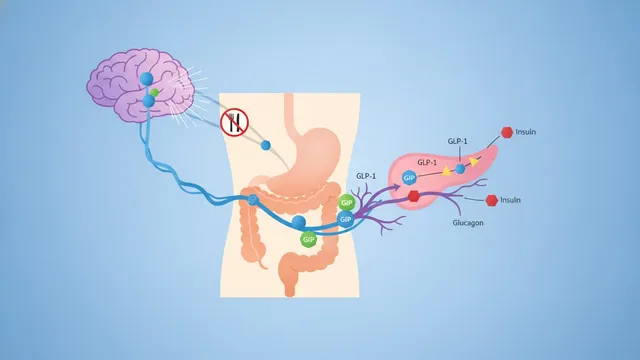
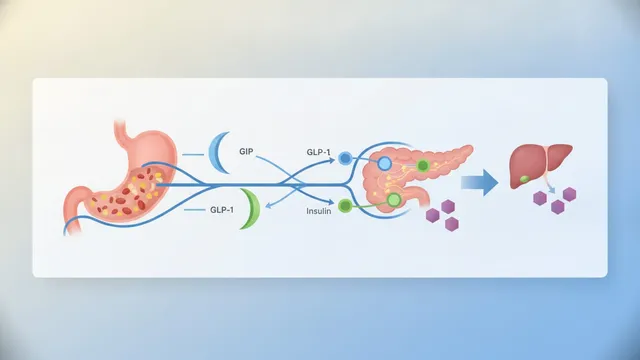
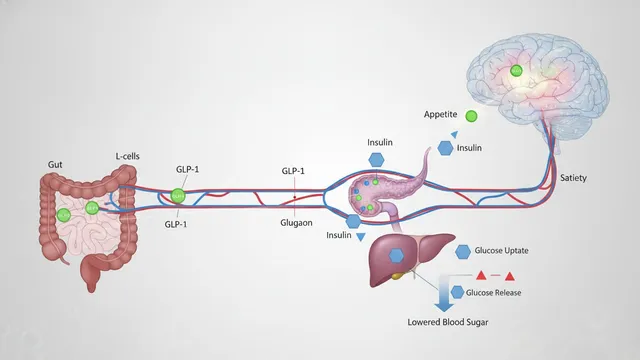
GLP-1 stands for glucagon-like peptide-1. It's a hormone your small intestine releases after you eat. It nudges your pancreas to release insulin when glucose is high, slows how fast your stomach empties, and signals satiety centers in the hypothalamus. Your own GLP-1 breaks down in a couple of minutes. The medications are engineered analogs that resist that breakdown and stay active for days.
Semaglutide is a GLP-1 receptor agonist. Tirzepatide is a dual agonist, acting on both GLP-1 and GIP receptors. Both are prescription-only medications in the United States and both require a licensed prescriber's evaluation. The National Institute of Diabetes and Digestive and Kidney Diseases maintains a plain-language overview of the approved prescription options if you want the regulator-adjacent version.
Why the appetite change feels so strange
Three things happen at once, and they stack.
Gastric emptying slows, so food sits longer and you feel physically full sooner. Satiety signaling in the brain increases, so the hunger drive quiets down. And for a lot of people, the mental chatter about food, what researchers sometimes call food noise, drops noticeably.
That last one surprised me most. It isn't willpower arriving late. It's a hormonal signal that was always supposed to be there doing its job more loudly.
What the evidence actually shows
The clinical trial literature is substantial and it's worth reading honestly, including the parts that complicate the story.
| Trial | Medication studied | Duration | Published average weight change | Noted limitation |
|---|---|---|---|---|
| STEP 1 (NEJM, 2021) | Semaglutide 2.4 mg weekly | 68 weeks | ~14.9% of body weight vs ~2.4% placebo | Combined with lifestyle intervention; GI side effects common |
| SURMOUNT-1 (NEJM, 2022) | Tirzepatide 5-15 mg weekly | 72 weeks | ~15-21% depending on dose | Same caveats; participants screened for eligibility |
| STEP 1 extension (Diabetes Obes Metab, 2022) | Semaglutide, after withdrawal | 1 year off treatment | Participants regained roughly two-thirds of lost weight | Treatment discontinuation matters |
Averages are not forecasts. Trial participants met specific criteria, received structured lifestyle support, and were monitored closely. Your individual response depends on your physiology, your dose tolerance, your adherence, and factors nobody can predict from a web page. I can't tell you what your number will be, and anyone who does is selling something.
That third row is the one I'd tattoo on the inside of my eyelids. Obesity behaves like a chronic condition. Treatment design has to account for what happens after the losing phase, not just during it.
How the program is designed around that mechanism
Everything below exists because of something specific the medication does. That's the test of good treatment program design: each component should trace back to a biological reason, not a brochure.
Patient assessment and eligibility
Before anything is prescribed, a licensed clinician reviews your health history, current medications, BMI and related measurements, and relevant labs. Personal or family history of medullary thyroid carcinoma or MEN2, a history of pancreatitis, certain gastrointestinal conditions, pregnancy or plans to become pregnant, and some drug interactions all change the calculus. The FDA's prescribing information for semaglutide products carries a boxed warning regarding thyroid C-cell tumors observed in rodent studies.
Not everyone is a candidate. A program that approves everyone isn't screening anyone.
Starting dose and the titration ladder
Nobody starts at a therapeutic dose. Clinical protocols begin low and step up over weeks because gastrointestinal tolerance builds with exposure. Start too high and you get nausea severe enough that people quit in month one.
Dosage optimization is not a race to the top of the ladder. The right dose is the lowest one producing a meaningful clinical response that you can actually tolerate and sustain. Some patients stay at a middle dose indefinitely. That's a legitimate outcome, not a failure to progress.
Side-effect management
Nausea, constipation, diarrhea, reflux, fatigue. Mostly dose-dependent, mostly front-loaded in the first weeks after each increase, mostly manageable with practical adjustments.
Hydrate. Seriously, more than you think.
Eat protein first, slowly, and stop when you're full rather than when the plate is empty. Keep portions small and frequent instead of three big meals. Expect fried and very fatty food to be less friendly than it used to be. And tell your care team early about anything persistent, because the fix is often a timing change or a slower titration, not white-knuckling it.
Severe or persistent abdominal pain, repeated vomiting, or signs of dehydration are not "push through it" territory. Those are call-your-clinician-now territory.
Nutrition and muscle preservation
When overall intake drops, some of the weight lost is lean mass. That's true of any significant weight reduction, not something unique to GLP-1 therapy. The counterweight is adequate dietary protein and resistance training, which the American College of Sports Medicine and most clinical weight management guidance support as part of structured programs.
Two sessions a week of basic resistance work. Protein at every meal. That's the floor, and it matters more as the months go on.
Monitoring, check-ins, and adjustment
This is the part that's invisible from the outside and does most of the work. Scheduled check-ins to review tolerance, weight trend, blood pressure, and relevant labs. Dose adjustments based on how you're actually responding rather than a fixed calendar. A documented way to reach a clinician between appointments.
The American Diabetes Association Standards of Care treat obesity pharmacotherapy as ongoing medical management requiring regular reassessment. Not a one-time prescription event.
Maintenance planning
Maintenance planning starts early, not at the end. It covers what happens when you reach a stable weight, whether a maintenance dose makes sense, what the plan is if you and your clinician decide to taper, and how to keep the habits that the medication made easier to build.
What's included in the TB2 Health program
Here's the honest inventory of what a medically designed program covers versus what it doesn't.
| Component | What it covers | Why it exists |
|---|---|---|
| Clinical intake and eligibility review | Health history, medications, measurements, contraindication screening | Determines whether treatment is appropriate at all |
| Prescriber evaluation | Licensed clinician reviews your case and decides on treatment | Prescription medications require it, legally and clinically |
| Individualized dosing plan | Starting dose, titration schedule, dose holds when needed | Tolerance varies widely between patients |
| Medication management | Pharmacy coordination, refill timing, storage and injection guidance | Gaps in supply disrupt titration |
| Ongoing check-ins | Scheduled reviews of progress, tolerance, and labs | Catches problems before they become reasons to quit |
| Side-effect support | Direct access when something feels wrong between visits | Most discontinuation happens over manageable issues |
| Nutrition and activity guidance | Protein targets, meal structure, resistance training basics | Protects lean mass and supports long-term maintenance |
| Maintenance strategy | Plan for the phase after active weight reduction | The withdrawal data makes this non-optional |
What's not included: a guarantee, a timeline, or a promise about any specific number on the scale. I'd rather lose your business than pretend otherwise.
Personalized versus one-size-fits-all
A one-size program hands everyone the same titration calendar and the same handout. A personalized plan starts from your labs, your medication list, your GI history, your schedule, and your tolerance, and it adjusts when reality disagrees with the plan.
The difference shows up in specific moments. The patient whose nausea spikes at a dose increase and needs to hold for four extra weeks. The patient on a blood pressure medication that needs dose review as weight changes. The patient who travels constantly and needs an injection schedule that survives time zones.
None of that is exotic. It's just attention.
Before you act on anything here
I'm not a clinician. Nothing in this article is medical advice, a diagnosis, or a treatment recommendation for you specifically. GLP-1 medications are prescription drugs with real contraindications, real side effects, and real interactions, and the only person qualified to decide whether one belongs in your treatment plan is a licensed prescriber who has reviewed your actual medical history.
Bring this article to that conversation if it helps you ask better questions. Don't use it as a substitute for one. If you're already a TB2 patient, your care team is the right first call for anything that feels off, including the stuff you'd normally be embarrassed to mention.
Where to go from here
If you read all of that and your reaction was "fine, but how much does it cost and will insurance touch it," that's a separate and completely reasonable question, and we keep the answer in one place rather than scattering it across a dozen pages.
And if you're somewhere earlier than that, still deciding whether this is even a door you want to walk through, there's no rush. The mechanism doesn't change if you take three more months to think about it. What I'd ask is that you evaluate any program, ours or anyone else's, on the scaffolding and not the headline. Ask who prescribes. Ask what happens at week six when you feel awful. Ask what the plan is at month eighteen.
Good programs have answers to all three.
You can see how our program is structured at tb2.health whenever you're ready. The intake takes about as long as a coffee break, and a clinician reviews every single one.
Paul Moss Co-founder, TB2 Health
This content is for informational/educational purposes only and is not medical advice, diagnosis, or treatment. Compounded versions of semaglutide/tirzepatide are not FDA-approved and their legal availability is limited to individual clinical necessity; they should not be considered equivalent to brand-name medications (Ozempic, Wegovy, Mounjaro, Zepbound). These are prescription medications that require clinical evaluation. They can cause gastrointestinal side effects (nausea, vomiting, diarrhea/constipation) and, rarely, pancreatitis, gallbladder issues, or changes in kidney function; they are not appropriate for everyone (e.g., history of medullary thyroid carcinoma/MEN2, pancreatitis, pregnancy).