

You're not worried about whether this works. You're worried about feeling awful on a Tuesday afternoon in a meeting you can't leave.
I get it. That was my exact hesitation too.
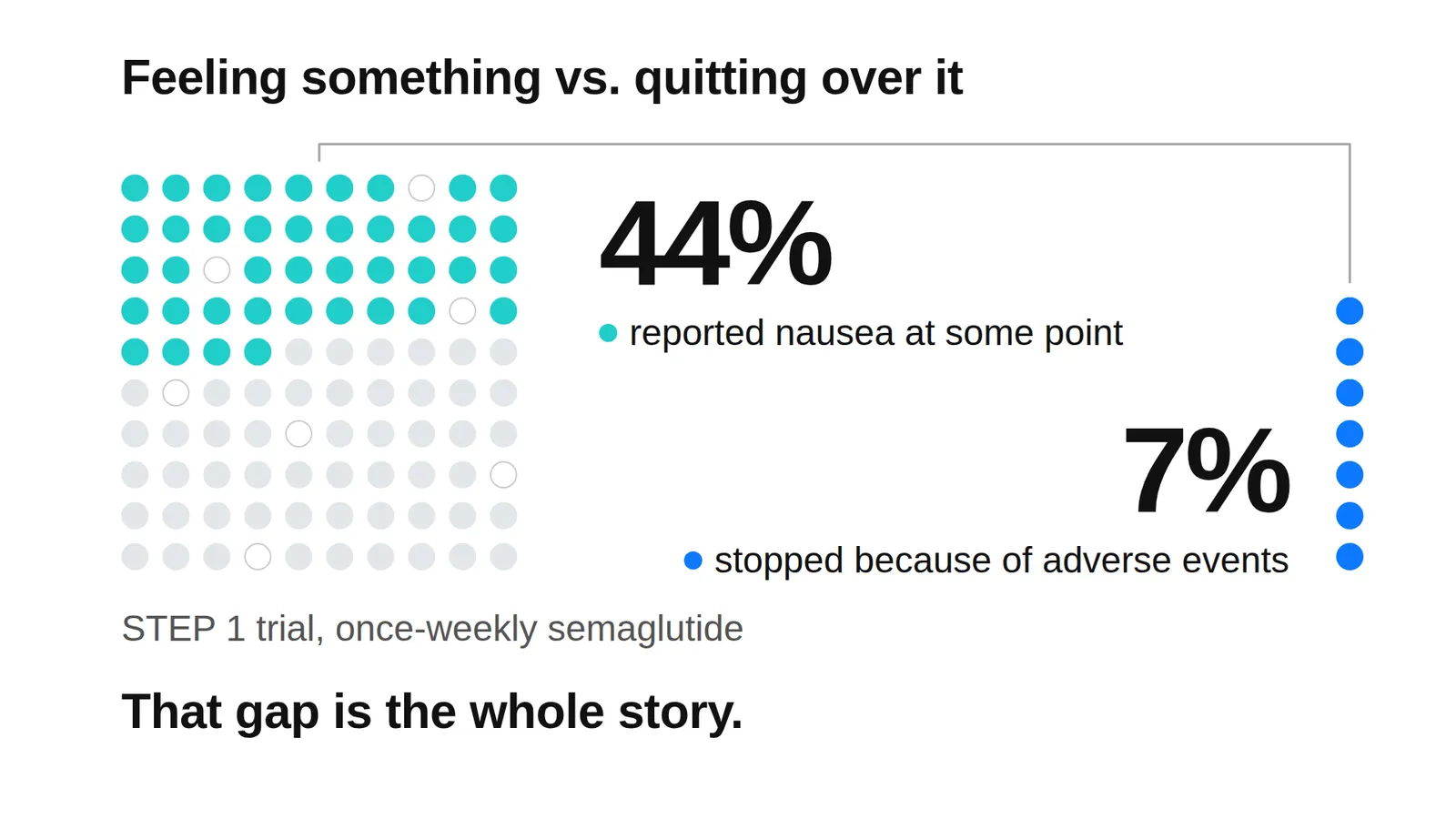
So let me give you the honest version up front: most people on a GLP-1 medication get some gastrointestinal side effects, most of those are mild to moderate, most show up during dose increases, and most settle down as your body adapts. In the STEP 1 trial of once-weekly semaglutide, about 44% of participants reported nausea at some point, compared with 17% on placebo, but only 7% stopped the medication because of adverse events (Wilding et al., New England Journal of Medicine, 2021). That gap between "felt something" and "quit over it" is the whole story.
The second honest part: a small number of side effects are serious and need a phone call, not a wait-and-see. I'll cover those too, because pretending they don't exist would be both dishonest and useless to you.

My own first eight weeks
I'm the co-founder of tb2.health and, somewhat inconveniently, patient zero. I went through the intake, the labs, the titration schedule, all of it.
Week one on the starting dose: almost nothing. I remember being faintly annoyed, like I'd been oversold a thunderstorm.
Week five, after the first dose step: different story. I had a dull, full feeling in my stomach that showed up around 4pm and hung around. I ate a normal-sized dinner out of habit and spent the next two hours deeply regretting it. Not dramatic. Just unpleasant, and entirely self-inflicted, because I'd been told to eat smaller portions and had decided that advice was for other people.
By week eight it had largely faded. What stuck around was constipation, which nobody warns you about with enough urgency, and which responded to boring interventions: more water, more fiber, more walking.
I'm not a clinician. I'm a guy who went through this and then spent two years reading trial data and listening to our medical team explain what they see across hundreds of patients. What follows is a blend of both.
Why these side effects happen at all
GLP-1 receptor agonists mimic a gut hormone your body already makes after eating. They slow how quickly your stomach empties, signal fullness to the brain, and in people with type 2 diabetes, improve glucose-dependent insulin release (NIDDK overview of prescription medications for overweight and obesity).
Slowed gastric emptying is the mechanism. It's also the side effect. Food sits longer, so you feel full sooner and stay full longer. Push past that signal with a large or very fatty meal and your stomach has a reasonable complaint.
This is why so much of side effect management comes down to changing how you eat rather than taking something for it. You're not fighting a random reaction. You're working with a predictable physiological change.
The common side effects, by the numbers
Here's what the two largest randomized trials reported. These are prescription-only medications, and these figures come from supervised clinical trials at specific doses.
| Side effect | Semaglutide 2.4 mg (STEP 1) | Placebo (STEP 1) | Tirzepatide 5-15 mg (SURMOUNT-1) | Placebo (SURMOUNT-1) |
|---|---|---|---|---|
| Nausea | 44.2% | 17.4% | 24.6-33.3% | 9.5% |
| Diarrhea | 31.5% | 15.9% | 18.7-23.0% | 7.3% |
| Vomiting | 24.8% | 6.6% | 8.3-12.2% | 1.7% |
| Constipation | 23.4% | 9.5% | 11.7-17.1% | 5.8% |
| Stopped due to adverse events | 7.0% | 3.1% | 4.3-7.1% | 2.6% |
Sources: Wilding et al., NEJM 2021 (STEP 1) and Jastreboff et al., NEJM 2022 (SURMOUNT-1).
Two things worth noticing. The placebo columns aren't zero, which tells you some of this is ordinary human digestion being observed closely for the first time. And the events clustered during dose escalation, then declined.
Other commonly reported effects include fatigue, headache, burping (sometimes with a sulfur note that is genuinely unpleasant), abdominal discomfort, and injection site reactions.
What actually helps, day to day
This is the part I wish someone had printed on a card and handed me in week one.
For nausea
Eat smaller. Then eat smaller than that. Half your old portion is a reasonable starting point.
Slow down. Put the fork down between bites. Nausea on a GLP-1 is very often a volume-and-speed problem wearing a costume.
Go easy on fried and high-fat food. Fat already slows gastric emptying on its own, so you're stacking two brakes.
Stop at "not hungry anymore," not at "full." The fullness signal arrives late now. By the time you register it, you've overshot.
Cold or room-temperature foods are often easier than hot, aromatic ones. Yogurt, cottage cheese, a protein shake.
Ginger tea is not a cure but it's cheap and some patients swear by it. Peppermint helps some people and worsens reflux in others. Experiment.
For constipation
Water first. Consistently, not heroically once a day.
Fiber, gradually. Berries, beans, oats, chia. Ramp slowly or you'll trade one problem for another.
Move. A 20-minute walk after dinner does more for gut motility than most things you can buy.
If that isn't enough, ask your clinician before reaching for a stimulant laxative. There are gentler first-line options, and your care team should be the one picking.
For diarrhea
Hydrate with something containing electrolytes, not just plain water. Watch for artificial sweeteners like sorbitol in "diet" products, which can make it worse. Bland, lower-fiber food for a few days is fine as a short-term bridge.
For fatigue
Fatigue on a GLP-1 is usually a calorie and hydration problem rather than a drug problem. If you're eating far less because food is no longer interesting, you can slide into under-eating without noticing. Eat, even if you're not hungry. Protein first. Most clinical programs, ours included, emphasize adequate protein intake and resistance training during active weight loss to support lean mass, which matters for how you actually feel (AGA Clinical Practice Guideline on pharmacological interventions for adults with obesity).
For sulfur burps
Smaller meals, less fat, less egg and red meat on heavy days. It's usually transient. It's also a conversation starter at home, which is one way to describe it.
When to stop managing and start calling
Most side effects are nuisances. A few are not. These warrant prompt medical attention, and in some cases emergency care.
| Warning sign | Possible concern |
|---|---|
| Severe, persistent abdominal pain, often radiating to the back, sometimes with vomiting | Pancreatitis |
| Pain in the upper right abdomen, fever, yellowing of skin or eyes, clay-colored stool | Gallbladder disease |
| Vomiting that prevents you from keeping fluids down for more than 24 hours | Dehydration, risk of acute kidney injury |
| No bowel movement with abdominal distension and vomiting | Ileus (added to GLP-1 labeling by the FDA in 2023) |
| Shakiness, confusion, sweating, rapid heartbeat (especially if you also take insulin or a sulfonylurea) | Hypoglycemia |
| Swelling of the face, lips or throat, trouble breathing, widespread rash | Serious allergic reaction |
| New or worsening vision changes if you have type 2 diabetes | Diabetic retinopathy complications |
| A lump or swelling in the neck, hoarseness, trouble swallowing or persistent shortness of breath | Requires evaluation per the boxed warning |
GLP-1 receptor agonists carry a boxed warning based on thyroid C-cell tumors observed in rodents. They are contraindicated in people with a personal or family history of medullary thyroid carcinoma or Multiple Endocrine Neoplasia syndrome type 2. Full prescribing details are available through the FDA's drug label database. This is one of the reasons a real medical history screening exists, and why "no prescription needed" is a phrase that should make you close the tab.
One more that catches people off guard: if you have an elective procedure requiring sedation or general anesthesia, tell the anesthesiologist you're on a GLP-1. Delayed gastric emptying affects fasting guidance, and multisociety guidance was updated in 2024 to address exactly this (American Society of Anesthesiologists). Don't assume it's in your chart. Say it out loud.
Dose escalation is a dial, not a ladder
Here's the single most useful reframe I can offer.
Titration schedules exist because starting low and increasing slowly reduces gastrointestinal side effects. But the printed schedule is a default, not a contract. If a dose step is making your life miserable, staying at your current dose longer is a legitimate clinical option. So is stepping back down.
Patients get this wrong constantly. They white-knuckle through a dose increase because they think moving up faster means moving forward faster, then they quit entirely in week nine. Slower and sustained beats faster and abandoned, every single time.
Signs it's worth raising with your clinician: nausea that isn't improving after two or three weeks at a dose, vomiting more than occasionally, side effects that are changing your work or sleep, or no change in appetite signals at all after several weeks at a given dose.
That conversation is routine. It is not a failure, and it is not a complaint. It is the point of being supervised.
What supervision actually changes
I'll be straightforward about where we fit, because this is the part that's relevant to your decision.
At tb2.health, side effect management isn't a disclaimer at the bottom of a shipment. It's the recurring work. Our program includes scheduled physician check-ins, dose adjustments based on how you're actually doing rather than a fixed calendar, direct messaging with a patient care coordinator when something comes up between visits, and screening at intake for the conditions that make these medications inappropriate for some people.
What that looks like in practice: a patient messages on a Thursday saying week six nausea is worse than week five. Instead of guessing or quitting, they get a response, usually a hold at the current dose plus specific eating adjustments, and a check-in two weeks later. That's it. Unglamorous. It's also the difference between people who stay in treatment and people who don't.
The clinician caveat, said plainly
Everything above is education, drawn from published trials, FDA labeling, and what I've learned working alongside our medical team. None of it is a diagnosis or a treatment plan for you.
I'm not a clinician. If you are experiencing a side effect, the right move is to contact your prescribing clinician or patient care coordinator, not to adjust your dose based on an article you read, mine included. If a symptom is in that warning-signs table, seek medical care now and read later.
That deference isn't legal cover. It's because the useful version of this advice always depends on your history, your other medications, and your labs, and I don't have any of those.
Where this leaves you
The fear of side effects is reasonable. It's also, in my experience, bigger before you start than during.
What you're probably picturing is a vague, open-ended misery. What most people actually get is a few weeks of needing to eat differently, a period of annoying constipation, and the slow realization that the portion sizes you considered normal were negotiable all along.
Some weeks will be worse than others. Plateaus happen. Dose steps sometimes land badly. None of that means the thing isn't working or that you've done something wrong. It means your body is adjusting, and adjustment is rarely linear.
Go in informed, go in supervised, and give yourself permission to go slowly. If you want to know whether this is a reasonable fit for your medical history, start with a consultation at tb2.health and ask every uncomfortable question on your list. The good clinicians want them.
Paul Moss Co-founder, TB2 Health
This content is for informational/educational purposes only and is not medical advice, diagnosis, or treatment. Compounded versions of semaglutide/tirzepatide are not FDA-approved and their legal availability is limited to individual clinical necessity; they should not be considered equivalent to brand-name medications (Ozempic, Wegovy, Mounjaro, Zepbound). These are prescription medications that require clinical evaluation. They can cause gastrointestinal side effects (nausea, vomiting, diarrhea/constipation) and, rarely, pancreatitis, gallbladder issues, or changes in kidney function; they are not appropriate for everyone (e.g., history of medullary thyroid carcinoma/MEN2, pancreatitis, pregnancy).