
Here's the honest answer: for a lot of people, both. Just not at the same time.
In the early weeks, some people feel flatter than usual. Then, as things settle and the underlying drivers of weight-related fatigue start to shift, most of the people I talk to describe the opposite. More steady energy. Fewer 3 p.m. crashes. Actually wanting to take the stairs.
I'm Paul Moss, co-founder of tb2.health and, for the record, patient zero of our own program. I'm not a clinician. But I've been the guy who napped in his car before a client meeting and told himself it was just a busy quarter, and I've since watched a few hundred patients go through the same arc. So let's talk about what's really going on with tiredness, before treatment and during it.

The short version
Fatigue is one of the more commonly reported side effects in GLP-1 clinical trials, and it tends to cluster around the first few weeks and around dose increases. In the STEP 1 trial published in The New England Journal of Medicine, fatigue was reported by roughly one in ten participants on active treatment versus about one in twenty on placebo. Real, but not universal, and usually not permanent.
Most of that early tiredness traces back to things that are fixable: eating far less than you realize, drinking less water than you need, losing electrolytes through GI side effects, and skipping protein because nothing sounds appetizing.
Meanwhile, the reasons you were exhausted before you started, the sleep that never restores you, the glucose rollercoaster, the deconditioning, tend to improve slowly and quietly over months. Which means the fatigue question isn't really "better or worse." It's "what kind of tired, and when."
Why you were already tired (and it wasn't laziness)
Before we blame any medication, let's be fair to the baseline. Weight-related fatigue is its own clinical picture, and it has several overlapping engines.
Sleep that doesn't actually restore you
Obstructive sleep apnea is wildly underdiagnosed. You can sleep eight hours and wake up feeling like you went three rounds with a mattress. The American Academy of Sleep Medicine has estimated that the large majority of moderate-to-severe cases in the U.S. go undiagnosed. If you snore, wake with a dry mouth or headache, or your partner has elbowed you awake because you stopped breathing, that's worth a conversation with your doctor regardless of what else you do.
Interestingly, the SURMOUNT-OSA trials published in NEJM in 2024 found that participants with obesity and moderate-to-severe OSA who received an incretin therapy had significant reductions in apnea-hypopnea events and improvements in patient-reported sleep-related impairment. That's a direct line between metabolic treatment and how rested you feel.
Blood sugar that won't hold still
Insulin resistance means your cells are slower to take up glucose, so you get spikes followed by dips. The dips feel like fog, irritability, and a powerful desire to lie down. If you've ever eaten a big lunch and needed to be horizontal by two, you know the sensation. The American Diabetes Association Standards of Care frames glycemic variability as a meaningful clinical target, not just an average number on a lab report.
Low-grade inflammation and deconditioning
Adipose tissue is metabolically active and contributes to chronic low-grade inflammatory signaling, which is part of why fatigue tracks with weight independent of sleep. Add in years of doing less because doing things is uncomfortable, and cardiorespiratory fitness quietly drops. Then ordinary tasks cost more energy. It compounds.
The labs nobody ran
Iron deficiency, low B12, low vitamin D, and hypothyroidism all cause fatigue and all get waved off as "you're just stressed." The NIH Office of Dietary Supplements notes that iron deficiency remains one of the most common nutrient deficiencies globally, and fatigue is often the first symptom. Get the bloodwork. It costs less than a month of guessing.
What actually happens to energy during treatment
Here's the pattern I see most often, described as a rough arc rather than a promise. Everyone's timeline is different, and some people skip the dip entirely.
| Phase | What people commonly report | Most likely driver |
|---|---|---|
| Weeks 1-4 | Flat, foggy, "running at 80%" | Sharp drop in calorie intake, dehydration, low electrolytes |
| Dose escalation weeks | A two to four day dip after a step up | Transient GI effects and reduced intake |
| Months 2-4 | Energy stabilizing, better mornings | Fewer glucose swings, improved sleep quality |
| Month 4 onward | Physical tasks feel cheaper | Reduced load, improved fitness, better sleep architecture |
| Any phase, persistent | Ongoing exhaustion that doesn't budge | Under-eating, protein gap, unaddressed deficiency or condition |
In the SURMOUNT-1 trial published in NEJM, fatigue was reported in the single-digit percentages across dose groups, higher than placebo but well below gastrointestinal effects like nausea. Across the larger GLP-1 trial literature, participants have also shown improvements in patient-reported physical functioning scores over time. So the data supports both halves of the answer: a real early signal, and a longer-term trend in the other direction.
Why the first several weeks can feel flat
You're eating less. That's the mechanism working. But "less" can slide into "nowhere near enough," and your body has opinions about that.
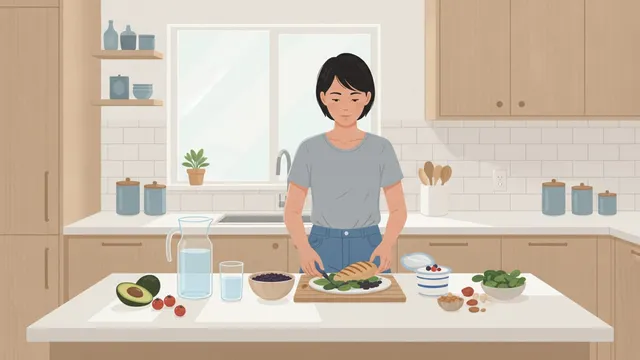
Eat, even when you're not hungry. This is the single most common fix. When appetite signaling drops, people accidentally land at 700 or 800 calories a day and then wonder why they can't think straight. Set meal times like appointments. Three small structured meals beat waiting for a hunger cue that isn't coming.
Protein first. Preserving lean mass during weight loss matters for metabolic rate and for how you feel, and higher protein intake during energy restriction is well supported in the literature (Cava et al., Advances in Nutrition). Ask your care team for a target that fits your body and kidney function. Then hit it before you fill up on anything else.
Hydrate, and salt it. Reduced food intake means reduced fluid and sodium intake, because a lot of both come from food. Add vomiting or loose stools and you're genuinely down on electrolytes. Plain water alone sometimes isn't enough. Many patients do better with an electrolyte mix in the morning. Clear this with your clinician if you have blood pressure or kidney considerations.
Respect the escalation week. If you feel a dip two days after a dose step, that's information, not failure. Front-load rest that week. Don't schedule your hardest workout and a red-eye flight on the same three days. Ask me how I know.
Keep moving, gently. Counterintuitive, I know. But a twenty minute walk beats a nap for mid-afternoon fog most days, and resistance training two or three times a week is the best available lever for protecting muscle while losing weight. The CDC's physical activity guidance is a reasonable target, but start where you are, not where the guideline is.
Audit your caffeine and alcohol. Both get louder when you're eating less. A coffee habit that used to be fine can start wrecking your sleep, which then gets blamed on the medication.
My own version of the dip
Week three for me was miserable in a very boring way. Not sick. Just switched off. I was drinking maybe 40 ounces of water a day, eating one real meal, and telling myself I was crushing it because the scale was moving. Our clinical team looked at my food log for about nine seconds and said, essentially, you're under-fueled and under-hydrated, fix both. Ten days later I felt normal. Nothing about my dose changed. I had just forgotten that the medication reduces appetite, not your need for nutrients.
When fatigue is a red flag, not a phase
Most tiredness is logistical. Some isn't. Contact your clinician promptly if fatigue comes with any of these:
- Dizziness, fainting, or a racing heart
- Shakiness, sweating, or confusion that resolves when you eat, especially if you also take insulin or a sulfonylurea
- Persistent vomiting or inability to keep fluids down
- Severe upper abdominal pain, with or without pain radiating to the back
- Shortness of breath or chest discomfort
- Low mood, hopelessness, or thoughts of self-harm
- Exhaustion that is getting steadily worse after week six rather than better
None of that is meant to alarm you. It's meant to save you from waiting it out when you shouldn't.
The part where I defer to people with actual medical degrees
I can tell you what patterns look like across a patient population and what my own week three felt like. I can't tell you whether your fatigue is a hydration problem, a thyroid problem, an iron problem, a sleep apnea problem, or a medication-timing problem. Nobody can do that from an article.
That's the whole reason our GLP-1 program is built around clinician oversight and a patient care coordinator rather than a prescription vending machine. Baseline labs, check-ins during escalation, and a real human to message when something feels off. Bring your specific symptoms to your prescriber or your PCC before you change anything about dosing, supplements, or intake. If you're evaluating whether a supervised program is the right fit, you can read how ours works at tb2.health.
Nothing here is medical advice, and individual results and experiences vary.
Where this leaves you
If you're already tired, the fear of getting more tired is a completely reasonable reason to hesitate. I'd just push back on one assumption: that your current energy level is your neutral baseline. It probably isn't. It's the output of sleep that isn't working, glucose that won't stabilize, and a body carrying a load it didn't sign up for.
Treatment can add a temporary dip on top of that. It can also start pulling out the reasons the baseline was low in the first place.
So if you decide to start, go in with a plan instead of a hope. Water bottle within arm's reach. Protein before anything else. A calendar that's soft the week after a dose change. And a clinician who picks up when you say something feels wrong.
The flat weeks pass. The habits you build getting through them are the ones that carry you through year two.
Paul Moss Co-founder, tb2.health