
If you've recently been told you have fatty liver — or you saw the words hepatic steatosis on a lab report and immediately Googled your way here — take a breath. You're not alone, and you're not doomed. But you are holding an important piece of information about your body, and I want to help you understand what it actually means.
I'm Paul. I co-founded tb2.health, and I spend a lot of my time reading, writing, and thinking about how the pieces of metabolic health fit together. Fatty liver is one of those pieces that gets dismissed as "no big deal" right up until it becomes one. So let's talk about it honestly.

What Fatty Liver Disease Actually Is
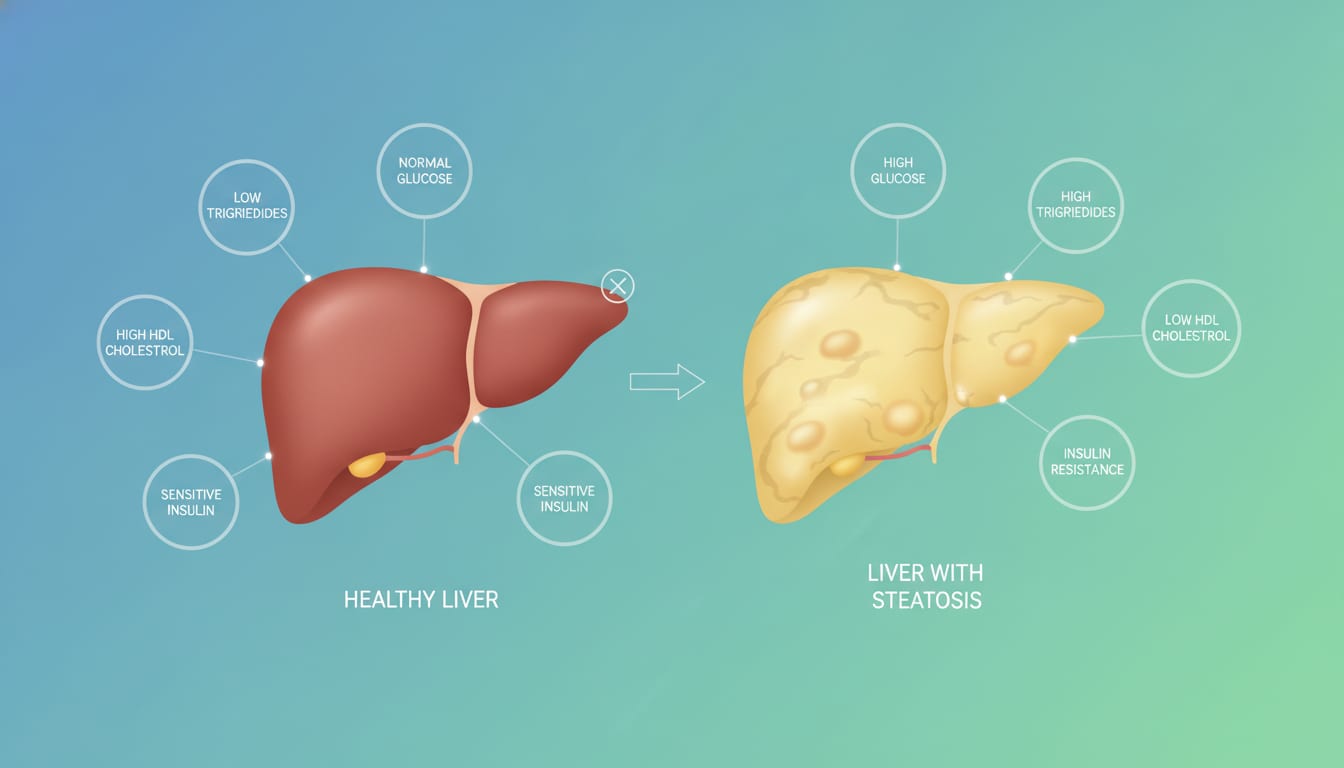
Fatty liver disease — technically called non-alcoholic fatty liver disease (NAFLD), and more recently renamed metabolic dysfunction–associated steatotic liver disease (MASLD) by the major hepatology societies — is exactly what it sounds like. Fat accumulates inside liver cells where it doesn't belong.
A little fat in the liver is normal. When more than about 5% of the liver's weight is fat, and it isn't caused by heavy alcohol use, that's NAFLD. It sits on a spectrum:
| Stage | What's Happening |
|---|---|
| Simple steatosis | Fat accumulation, minimal inflammation |
| NASH (steatohepatitis) | Fat + inflammation + liver cell damage |
| Fibrosis | Scar tissue starts forming |
| Cirrhosis | Extensive scarring, impaired liver function |
Roughly 1 in 4 adults globally has NAFLD, according to a widely cited meta-analysis in Hepatology. In the U.S., it's the most common chronic liver condition. Most people with it feel nothing at all. That's part of what makes it tricky.
Why This Isn't Just a "Liver Problem"
Here's the part I really want you to understand: your liver didn't get fatty in a vacuum.
NAFLD is almost always a downstream signal of insulin resistance and metabolic syndrome. The liver is a central metabolic organ — it processes carbohydrates, fats, and hormones — so when your body's insulin signaling starts to falter, the liver is one of the first places the mess shows up.
The American Association for the Study of Liver Diseases and the American Diabetes Association both now treat fatty liver as a cardiometabolic condition, not just a hepatic one. That reframing matters. It means your liver ultrasound isn't a standalone finding — it's a window into how your whole metabolism is running.
The Cluster You Should Know About
Fatty liver rarely travels alone. It's usually part of a cluster that includes some combination of:
- Elevated fasting glucose or type 2 diabetes
- High blood pressure
- Elevated triglycerides, low HDL cholesterol
- Increased waist circumference
- Insulin resistance (even without a diabetes diagnosis yet)
If you have three or more of those, you meet the criteria for metabolic syndrome. And metabolic syndrome dramatically raises your risk not just of liver progression, but of cardiovascular disease — which, ironically, is what actually kills most people with NAFLD long before their liver does. The NIH has good plain-language resources on this if you want to dig deeper.
How the Liver Gets This Way
I'm not a clinician, so I'll keep this at the level a smart friend would explain over coffee.
When you eat more energy than your body can readily use — especially from refined carbs and sugar — insulin rises to shuttle glucose into cells. Over years, cells stop responding as sharply. Insulin levels stay elevated. The liver, sensing that surplus energy, starts converting it into fat and storing it locally. That's de novo lipogenesis, and it's a major driver of NAFLD.
Layer on visceral fat around the abdominal organs, hormonal shifts (menopause is a common inflection point), poor sleep, sedentary time, and the occasional genetic predisposition — and you have the recipe.
The good news: the liver is remarkably regenerative. Fat can come out. Inflammation can quiet down. Even early fibrosis can improve. But the intervention has to address the metabolic root, not just the liver in isolation.
What Actually Moves the Needle
Current clinical guidance from bodies like the AASLD Practice Guidance on NAFLD is consistent on the foundation:
Weight reduction. A 5% loss of body weight typically reduces liver fat. 7–10% often improves inflammation and, in many patients, early fibrosis. That's not me overpromising — that's what the trials show.
Dietary pattern. Mediterranean-style eating has the strongest evidence base for NAFLD. Less ultra-processed food, less added sugar (especially fructose), more fiber, more olive oil, more fish.
Movement. Both aerobic and resistance training reduce liver fat independent of weight loss. You don't have to become a triathlete. Consistency beats intensity.
Sleep and alcohol. Poor sleep worsens insulin resistance. Alcohol — even at "moderate" levels — adds a workload the fatty liver doesn't need.
Managing the co-travelers. Blood pressure, lipids, glucose, and thyroid function all deserve attention. Fatty liver is a team sport.
There's also a growing body of research on how metabolic therapies — including newer classes of medication used for type 2 diabetes and obesity — affect liver fat and inflammation. That's a conversation worth having with a clinician who understands the full metabolic picture, not just one organ at a time.
A Note on Getting the Right Workup
If you've been told you have fatty liver, ask your clinician about:
- FIB-4 score — a simple calculation from routine labs that estimates fibrosis risk
- Elastography (FibroScan) if fibrosis risk looks elevated
- A full metabolic panel: HbA1c, fasting insulin, lipid panel, blood pressure trending
- Screening for sleep apnea if you snore or wake unrefreshed — it's strongly linked
I'm not here to diagnose you or replace your doctor. Please don't take anything above as a substitute for a proper clinical evaluation. What I can tell you is that fatty liver deserves a workup that looks at the whole metabolic system — not a shrug and a "come back in a year."
The Forward View
Here's what I hope you take away: a fatty liver diagnosis isn't a verdict. It's an early warning system doing its job. Your body is telling you something about how energy, insulin, and inflammation are moving through you — and it's telling you now, while there's meaningful room to change the trajectory.
That's actually a gift, even if it doesn't feel like one today.
Learn what your numbers mean. Find a clinician who treats metabolic health as one connected system. Start with the foundations — food, movement, sleep — and give them enough time to show you what they can do. And keep reading. Understanding what's happening inside you is the first real step toward changing it.
You've got more agency here than the diagnosis makes it sound.