

You have probably seen the IV drip menu. NAD+, $400 a bag, two hours in a recliner with a lavender eye mask, promising cellular renewal. Or the capsule on your counter that costs more per month than your gym membership.
I want to give you the honest version. Not the hype version, and not the cynic's version either, because both are lazy.
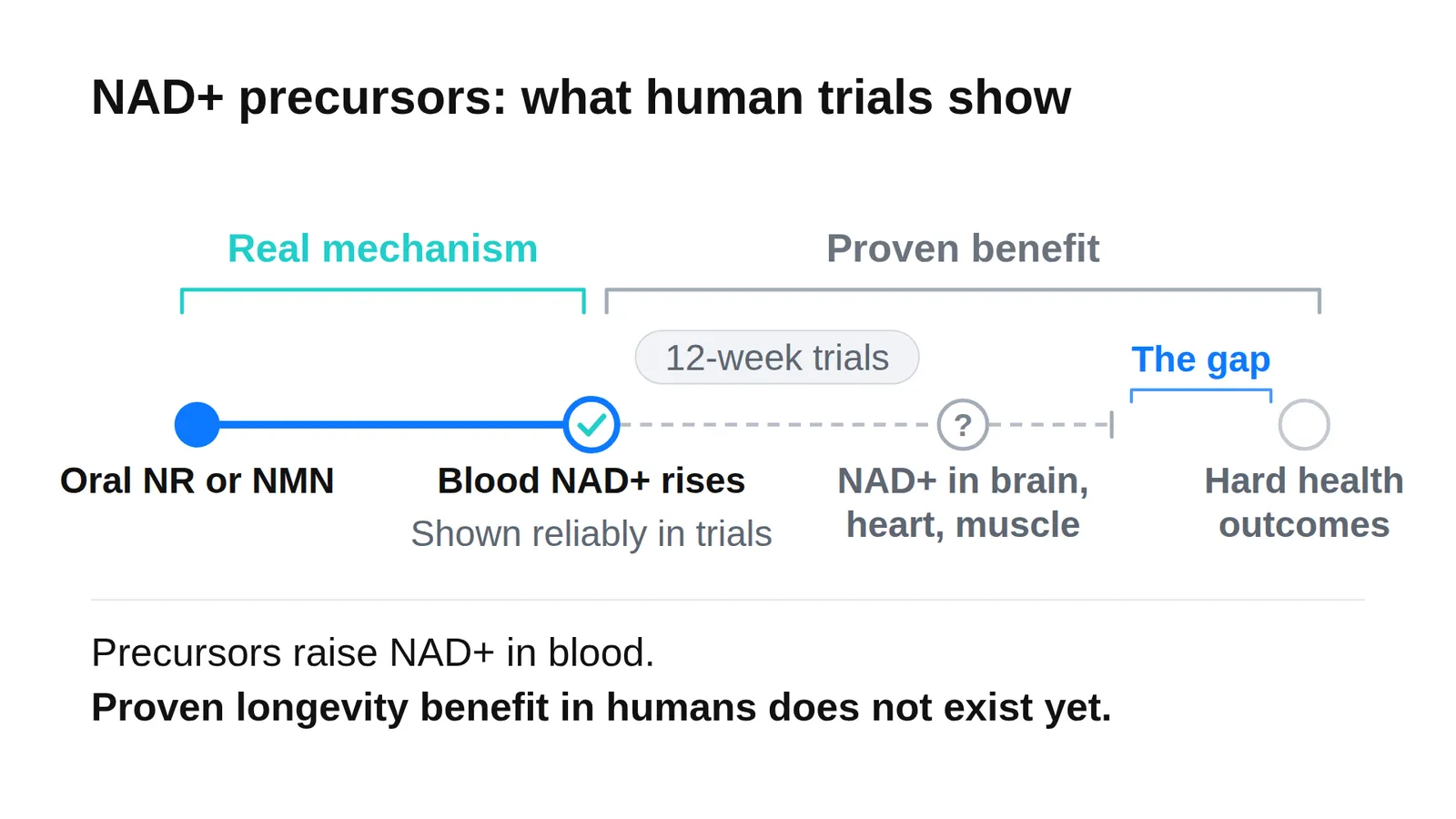
Here it is up front: the biology of NAD+ is real, well-characterized, and genuinely important. The human evidence that raising NAD+ with a supplement or an infusion makes you healthier, stronger, or longer-lived is thin. Small trials. Short durations. Surrogate endpoints. Mixed results. That gap between "real mechanism" and "proven benefit" is the whole story, and anyone selling you NAD+ without naming that gap is selling you something other than information.

My own skin in this game
I co-founded tb2.health and I have been its most annoying test subject since day one. I have run GLP-1 therapy on myself, tracked it obsessively, and written about the ugly parts. So when NAD+ started showing up in every longevity podcast, I did what I always do. I tried it.
I booked the IV. Halfway through, I got the chest tightness and the slightly nauseated, wound-up feeling that a lot of people report when the drip runs fast. The nurse slowed it down. I felt fine afterward. Pleasantly alert, possibly because I had just sat still for two hours and paid a lot of money to do it. Two days later I felt exactly like myself.
Then I ran oral nicotinamide riboside for about four months because the pharmacology at least made sense to me. Did I feel a difference? Honestly, marginal and unreliable. Sleep was the same. Training recovery was the same. Nothing bad happened either.
I am not a clinician. I am a founder who reads trials and then calls our medical team to tell me where I am wrong. What follows is what the literature actually supports, and where it stops.
What NAD+ actually does
Nicotinamide adenine dinucleotide is a coenzyme in essentially every cell you have. It does two very different jobs.
The first is redox chemistry. NAD+ shuttles electrons through glycolysis, the TCA cycle, and oxidative phosphorylation. In that role it is recycled, not consumed. Your cells cycle through it constantly.
The second job is the interesting one for aging research. NAD+ is a substrate, meaning it gets used up, for three families of enzymes: sirtuins (which regulate gene expression and metabolic signaling), PARPs (which respond to DNA damage), and CD38 (a surface enzyme that ramps up with inflammation). Every time one of those enzymes fires, it consumes NAD+ and spits out nicotinamide.
So NAD+ sits at the intersection of energy metabolism, DNA repair, and inflammatory signaling. That is not marketing. That is a well-reviewed piece of cell biology, summarized nicely in Covarrubias et al., Nature Reviews Molecular Cell Biology, 2021.
Your body makes NAD+ three ways: from tryptophan (the de novo pathway), from nicotinic acid (the Preiss-Handler pathway), and most of the time from recycled nicotinamide through the salvage pathway, with NAMPT as the rate-limiting step. Nicotinamide riboside and nicotinamide mononucleotide feed into that salvage route.
The decline story, with the caveats restored
The pitch you hear is simple: NAD+ falls roughly 50% by middle age, so put it back. The real picture is messier.
Measured declines show up clearly in some human tissues, notably skin, and in various rodent tissues. But results vary a lot by tissue, by measurement method, and by study. Skeletal muscle, for example, has not shown a consistent age-related NAD+ collapse across human studies. Sample handling matters enormously because NAD+ degrades fast after collection, which is one reason direct-to-consumer "NAD+ level" blood tests should be treated as curiosities rather than diagnostics.
And there is a mechanistic wrinkle that gets skipped: a meaningful part of the decline may come from increased consumption rather than reduced production. CD38 expression rises with age-associated inflammation, and CD38 eats NAD+. If that is the dominant driver in a given tissue, pouring in more precursor is a bit like refilling a bucket without looking at the hole.
That is not a reason to dismiss precursors. It is a reason to be skeptical of the plumbing metaphor you see in the ads.
What the human trials actually found
This is the section most NAD+ content skips. Here is a fair summary of the better-known controlled human work on oral precursors.
| Study | Population | Dose and duration | What it found |
|---|---|---|---|
| Trammell et al., Nature Communications, 2016 | Healthy adults | Single doses of NR up to 1,000 mg | Established that oral NR reliably raises the blood NAD+ metabolome. Pharmacokinetics, not outcomes. |
| Martens et al., Nature Communications, 2018 | Healthy middle-aged and older adults | 1,000 mg NR daily, 6 weeks | Well tolerated, raised NAD+. A modest systolic blood pressure signal in participants with elevated readings, explicitly described as exploratory. |
| Dollerup et al., American Journal of Clinical Nutrition, 2018 | Men with obesity and insulin resistance | 2,000 mg NR daily, 12 weeks | No improvement in insulin sensitivity, mitochondrial function, or body composition. |
| Elhassan et al., Cell Reports, 2019 | Older men | 1,000 mg NR daily, 21 days | Raised the muscle NAD+ metabolome modestly. No change in mitochondrial bioenergetics. Some reduction in circulating inflammatory cytokines. |
| Yoshino et al., Science, 2021 | Postmenopausal women with prediabetes (n=25) | 250 mg NMN daily, 10 weeks | Improved muscle insulin signaling and sensitivity. No change in body composition, blood pressure, or most other measures. |
Read that table again and notice the pattern. Precursors reliably do the thing they are supposed to do biochemically: they raise NAD+ and its metabolites in blood, and to a lesser extent in tissue. What they have not consistently done is move hard clinical outcomes in healthy or metabolically impaired humans over weeks to months.
Longer and larger trials exist now, including year-long studies in neurodegenerative disease, and the pattern so far has been sober rather than spectacular. Nothing yet reproduces the headline mouse results that started this whole wave. You can browse the active and completed work yourself on ClinicalTrials.gov.
Three honest reasons the human data might be thin that have nothing to do with NAD+ being useless: the trials are short relative to an aging process measured in decades, the participants are often already healthy (hard to improve), and we still do not know whether raising blood NAD+ meaningfully raises it in the tissues that matter, like brain and heart.
Equally honest: "the trials were designed wrong" is the oldest excuse in supplement marketing. Keep both possibilities open.
The precursor menu, compared
| Form | How it gets to NAD+ | Human evidence | Regulatory reality (U.S., as of 2026) |
|---|---|---|---|
| Nicotinamide riboside (NR) | Via NRK1/2 to NMN, then NAD+ | The deepest oral dataset. Multiple RCTs, consistently well tolerated at 1,000 to 2,000 mg/day in studies up to 12 weeks | Marketed as a dietary supplement with accepted new dietary ingredient notifications |
| Nicotinamide mononucleotide (NMN) | Salvage pathway, likely after conversion at the cell surface | Fewer trials, mostly small, some positive surrogate findings | Legal as a dietary supplement. FDA reversed its 2022 exclusion in September 2025; new dietary ingredient notification requirements still apply |
| Niacin (nicotinic acid) | Preiss-Handler pathway | Decades of data, mostly as a lipid agent at gram doses | Established vitamin. Flushing is common. High doses have real hepatic risk. See the NIH Office of Dietary Supplements |
| Nicotinamide (niacinamide) | Direct salvage substrate | Well studied in dermatology and as a vitamin | Established vitamin. Theoretical concern about sirtuin inhibition at very high doses |
| IV or injectable NAD+ | Direct infusion of the intact molecule | Very limited controlled data. Pharmacokinetics poorly characterized. Infusion-rate symptoms are common | Not an FDA-approved drug. FDA maintains a bulk drug substances list for 503A compounding where NAD has unresolved questions |
The IV row deserves emphasis because it is the most aggressively marketed and the least supported. Infusing the whole dinucleotide is pharmacologically odd. NAD+ is a large, charged molecule, and the evidence that intravenous delivery produces better tissue loading than an oral precursor is not there in any robust form. What IV does produce reliably is a bill and, if the drip runs fast, a strange hour.
Also worth naming: a methyl-donor question. Clearing excess nicotinamide uses NNMT, which consumes SAM methyl groups. At very high chronic doses this is a theoretical concern. It is not well quantified in humans, and I would rather tell you it is an open question than pretend it is settled in either direction.
How I actually think about this
If you want my working position, here it is, held loosely and revised when the data moves.
NAD+ precursors are a reasonable, low-drama experiment for a healthy adult who has already handled the things with far better evidence behind them. Sleep. Resistance training. Protein intake adequate to preserve muscle. Blood pressure, lipids, and glucose in range. If those are not in order, a $90 bottle of NR is the most expensive form of procrastination available.
If you do try it: pick a form with actual human pharmacokinetic data, use a dose that was studied rather than a dose that was invented, buy from a manufacturer that publishes third-party testing, and give it a defined trial window with something you are actually measuring. Track it. Otherwise you are just paying a subscription to feel proactive.
And set your expectations where the evidence sets them. Tolerability in trials has been good. Proven longevity benefit in humans does not exist yet. Those are two different sentences and you should keep them apart.
This is also where I will say the quiet part about our own category. At tb2.health we offer physician-supervised NAD+ plans (alongside semaglutide and tirzepatide; we do not offer peptides), and the thing we are actually selling is the supervision: a licensed clinician reviewing your history and labs, deciding whether a protocol makes sense for you at all, and following up. Not a promise about the molecule. Anyone who promises you the molecule is skipping the part that protects you.
Please talk to a clinician, genuinely
I am a founder and a well-read patient, not a physician, and nothing here is a diagnosis or a prescription. NAD+ precursors can interact with medications and may be inappropriate in some conditions, and injectable or infused forms carry an entirely different risk profile from a capsule. Active cancer is a specific situation where the sirtuin and PARP biology cuts in directions nobody should guess at casually.
Bring this article to your physician or to our patient care team and let someone with a license look at your actual labs, your actual medication list, and your actual goals. If a provider will sell you an NAD+ protocol without reviewing any of that, that tells you what kind of operation it is.
What would change my mind
I would move from "plausible, unproven" to "worth broad recommendation" on three kinds of evidence: multi-year trials rather than 12-week ones, hard endpoints rather than biomarkers, and direct demonstration that raising circulating NAD+ raises it where it counts, in brain, heart, and muscle, in living humans.
Some of that work is running right now. That is the genuinely exciting part. NAD+ is one of the few longevity ideas that came from real mechanistic biology rather than from a marketing department, which means it is testable, and it is being tested.
Until those readouts land, stay curious and keep your money close. The boring interventions still beat the shiny ones, and the person who sleeps seven and a half hours, lifts twice a week, and eats enough protein is going to out-age the person with the best supplement stack and none of that. If you want to add NAD+ on top of a foundation you have already built, do it with your eyes open and a clinician in the loop. That is not a hedge. That is just how you run an experiment on yourself without getting hurt.
Keep reading the trials with me. I will update this when the next one lands.
Paul Moss Co-founder, TB2 Health
This article is educational and is not medical advice. NAD+ and its precursors are not FDA-approved to treat, cure, or prevent any disease. Discuss any supplement or protocol with a licensed healthcare provider before starting.