
Ever wondered what's actually happening inside your body when a GLP-1 medication does its thing? Not the marketing version. The real mechanism.
Let's get into it.
I'm Paul Moss, co-founder of tb2.health and — full disclosure — patient zero of our own GLP-1 program. Before I ever pitched this to a friend or ran a single ad, I ran the protocol on myself. And the question I got most, from friends, family, and skeptics at dinner parties, was always some version of the same thing: So what does it actually do?
Fair question. Let me answer it properly.

The Short Answer, Up Front
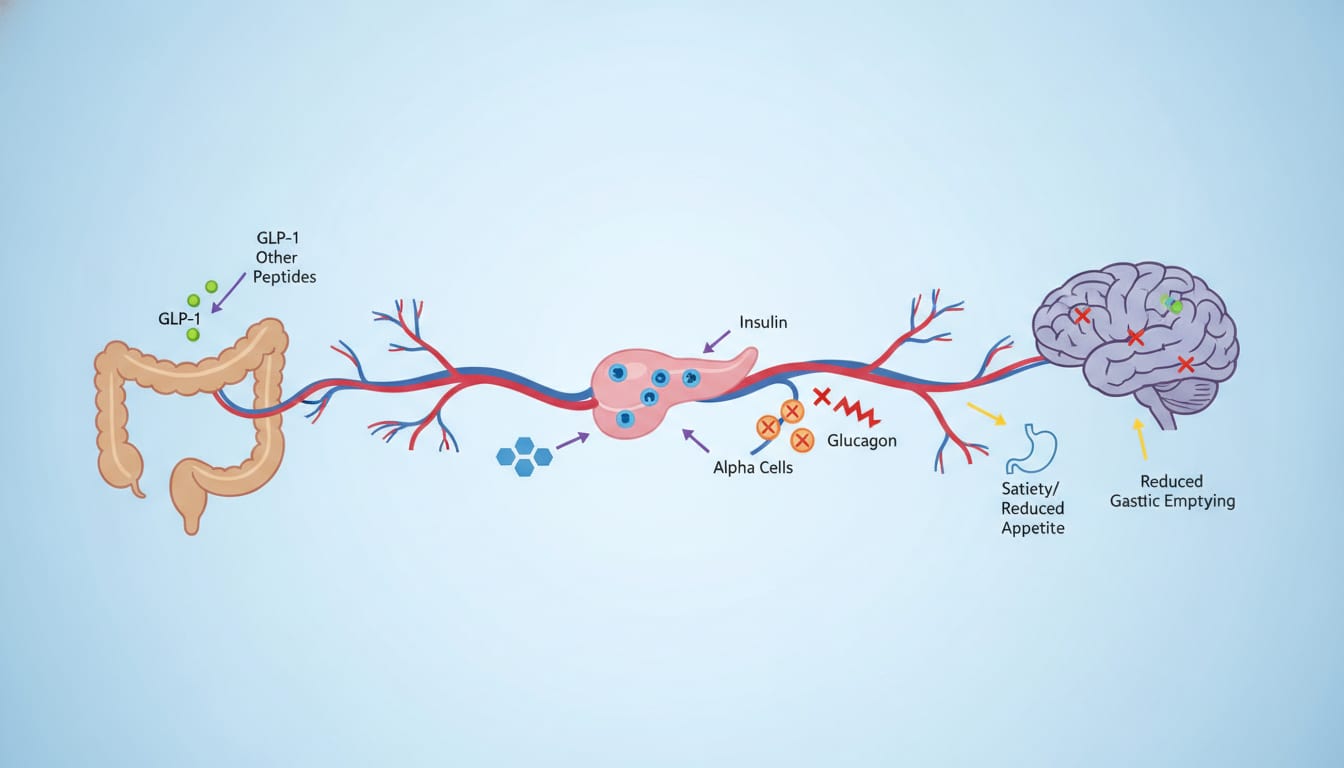
GLP-1 medications mimic a hormone your gut already makes — glucagon-like peptide-1 — that your body naturally releases after you eat. That hormone does four main jobs:
- Tells your pancreas to release insulin when blood sugar rises
- Suppresses glucagon (the hormone that raises blood sugar)
- Slows how fast your stomach empties
- Signals your brain that you're full
The medications are engineered versions of that hormone that last days instead of minutes. That's really the whole trick. Everything else is downstream of those four mechanisms.
Now the longer version — because if you're going to put a molecule in your body every week, you deserve to understand what it's doing in there.
Meet Native GLP-1: The Hormone You Already Have
Your small intestine has specialized cells called L-cells. When food shows up — particularly carbs and fats — those L-cells release GLP-1 into your bloodstream. This has been well characterized in the literature for decades (Drucker, 2018, Cell Metabolism).
The problem? Native GLP-1 has a half-life of about two minutes. An enzyme called DPP-4 chews it up almost immediately. So evolution gave us this elegant post-meal signaling system that flames out before most of us have finished chewing.
That's the gap the medications close.
What the Engineered Molecules Do Differently
The GLP-1 receptor agonists used in clinical weight loss protocols today are structurally modified so DPP-4 can't degrade them as fast. Some also bind to albumin in your bloodstream, which acts like a slow-release reservoir. The result: a molecule that keeps activating GLP-1 receptors for roughly a week instead of two minutes.
Same receptors. Same signaling. Just… sustained.
The Four Mechanisms, One at a Time
1. Glucose-Dependent Insulin Release
When blood sugar rises after a meal, GLP-1 tells your pancreatic beta cells to secrete insulin. The key word is glucose-dependent — meaning it only kicks in when your blood sugar is actually elevated. That's a big deal, because it's why GLP-1 medications carry a much lower risk of hypoglycemia than older diabetes drugs like sulfonylureas (American Diabetes Association Standards of Care, 2025).
2. Glucagon Suppression
Glucagon is insulin's opposite number — it tells your liver to dump stored glucose into your bloodstream. Useful when you're fasting. Not useful when you've just eaten. GLP-1 puts the brakes on inappropriate glucagon release, which helps flatten post-meal glucose spikes.
3. Delayed Gastric Emptying
Your stomach empties slower. Food sits longer. This is a big part of why patients report feeling full on portions that used to leave them hungry — and also why the most common side effects are GI-related: nausea, reflux, that "I ate a brick" feeling if you overdo it at dinner.
Soft imperative: Eat slower. Eat less at each sitting. Your stomach is not the same stomach it was three weeks ago.
4. Central Appetite Regulation
This is the one people underestimate. GLP-1 receptors exist in your brain — specifically in the hypothalamus and the brainstem — where they modulate the reward and satiety circuits that decide whether you want a second helping, whether the ice cream in the freezer is calling your name at 10 p.m., whether the drive-through feels like a good idea on the way home.
Patients describe it as "the food noise got quiet." That's not a marketing phrase. That's neurobiology. A 2024 review in Nature Reviews Endocrinology walks through the central nervous system pathways in detail if you want to go deeper.
Semaglutide vs. Tirzepatide: Not Identical Twins
The two leading molecules in clinical weight loss protocols today share the GLP-1 mechanism above, but they aren't the same.
| Feature | Semaglutide | Tirzepatide |
|---|---|---|
| Receptors activated | GLP-1 only | GLP-1 and GIP |
| Half-life | ~7 days | ~5 days |
| Dosing | Weekly | Weekly |
| Mechanism class | Single agonist | Dual agonist |
That second column — GIP — is a different gut hormone (glucose-dependent insulinotropic polypeptide) that also plays a role in insulin secretion and fat metabolism. Whether adding GIP action produces meaningfully different clinical results in any individual patient is a conversation for your prescriber, not a marketing chart.
I'm not a clinician. Which molecule is right for you depends on your labs, your history, your tolerance profile, and your goals. That's the clinician's call, not mine and not the internet's.
What This Means for Your Treatment
Understanding the mechanism changes how you show up to treatment. A few practical translations:
- Titration is not a marketing gimmick. Doses start low and step up because your gut needs time to adapt to slower emptying. Skipping ahead is how you end up on the bathroom floor.
- Protein and hydration matter more, not less. Slower gastric emptying plus reduced appetite means you can accidentally under-eat protein and under-drink water. Hydrate. Prioritize protein. Every day.
- The medication is a tool, not a driver. It quiets the noise. What you do in the quiet — the food choices, the resistance training, the sleep — is what builds the outcome.
- Labs before you start aren't optional. Baseline metabolic panels, thyroid, kidney function — these exist so your clinician can prescribe safely and adjust intelligently. Pre-treatment lab work is part of any legitimate program.
Where TB2 Health Fits
At tb2.health, we run a physician-supervised GLP-1 program built around three things: a proper initial health evaluation, pre-treatment labs, and ongoing dosage optimization with a clinician who actually knows your file. Not a chatbot. Not a form-and-forget prescription.
The mechanism above is why the supervision matters. GLP-1 medications affect insulin, glucagon, gastric motility, and central appetite regulation — four different systems simultaneously. That's not something to manage on autopilot.
A Word from the Non-Clinician
Everything above is educational. It's not medical advice, it's not a diagnosis, and it's not a prescription. If you're weighing whether GLP-1 therapy makes sense for your situation, that conversation belongs with a licensed clinician who can look at your history, your labs, and your goals as a whole. Our patient care coordinators can get you into that conversation — but the conversation itself is the point, not a formality.
The Bottom Line
The mechanism isn't magic. It's a well-characterized gut hormone, engineered to last, doing four jobs your body already knows how to do — just more consistently than your own biology can manage on its own.
Understand that, and everything else about treatment — the titration schedule, the side effect profile, the nutrition guardrails, the labs — stops feeling arbitrary and starts making sense.
If you're curious whether this fits your situation, come find out. Ask questions. Bring the skeptical ones — those are usually the best.
You don't need to have it all figured out before you start. You just need to start figuring it out.